Case Study
Case 26: Painful Fissure at the Corner of the Mouth — A Clinical Look at Angular Cheilitis
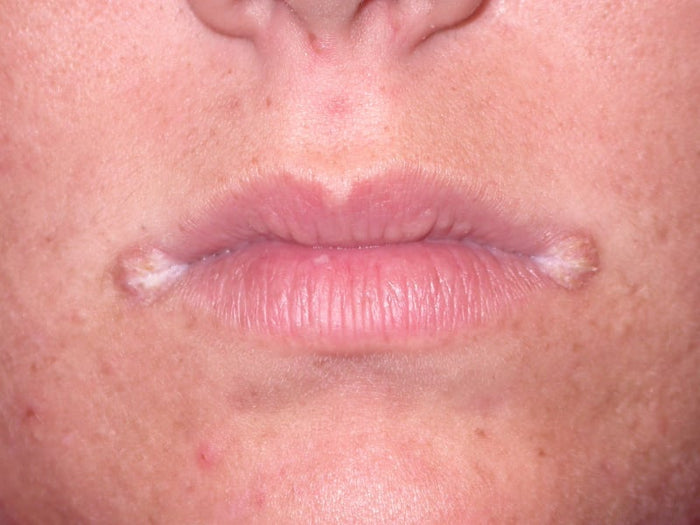
Quick Answer: A fissure (crack) at the angle of the mouth with surrounding redness and crusting is angular cheilitis. The main causes are infection — usually the yeast Candida, occasionally bacteria (Staph aureus) — and nutritional deficiencies, with saliva pooling and maceration at the mouth corners as the underlying mechanism. Work-up includes iron and vitamin B2, B6, B12 levels and swab tests where needed; treatment combines barrier creams with prescribed antifungal or antibacterial creams, and oral antifungals in selected cases. Case Snapshot: A worried patient on r/DermatologyQuestions sought help for a persistent sore at the mouth corner. On examination-style review of the images: fissuring with surrounding erythema (redness) over the left corner of the mouth, followed by crusting, with incidental Fordyce spots on the lips — a textbook presentation of angular cheilitis. The Anatomy of the Problem The angular commissures — the mouth corners — are the perfect storm for skin breakdown: they fold, they flex with every word and bite, and they collect saliva. Pooling of saliva causes physical maceration — the skin becomes waterlogged, soft, and fragile — and macerated skin splits. Once split, the warm moist crevice becomes an ideal culture plate. The Causes, Ranked Infective — the leading cause: overgrowth of Candida (a yeast) in the macerated corner; rarely bacterial, chiefly Staphylococcus aureus Nutritional: deficiencies of iron and B-vitamins (B2, B6, B12) impair the skin's repair capacity, turning a minor crack into a non-healing fissure Mechanical contributors: deep corner folds (age-related volume loss, dentures, bite changes) that increase saliva pooling The Rational Work-Up Rather than guessing, stubborn or recurrent cases get targeted tests: Blood work: iron studies and vitamin B2, B6, B12 levels — correcting a deficiency is sometimes the entire cure Swab tests from the fissure — Gram stain, KOH preparation, or culture — to confirm whether yeast, bacteria, or both are present, directing precise treatment The Treatment Ladder Barrier protection first: a bland barrier cream or lip balm applied frequently shields the corner from saliva — the mechanical fix without which everything else struggles Topical anti-infectives as prescribed: an antifungal cream such as clotrimazole for candidal cases, or an antibacterial cream such as mupirocin where bacteria are implicated Oral antifungal therapy — a dermatologist-prescribed course (such as fluconazole) reserved for extensive, resistant, or recurrent candidal cases Correct the underlying contributors: replace deficient iron/vitamins, address denture fit, and treat any associated lip-licking habit Most cases respond within one to two weeks once the right combination is in place; the commonest reason for failure is treating only the infection while the saliva-pooling and deficiency drivers continue untouched. The Fordyce Spot Footnote The incidental Fordyce spots noted on this patient's lips deserve a line of reassurance: these are normal, harmless visible oil glands, unrelated to the cheilitis, requiring no treatment — a finding, not a problem (covered fully in our dedicated Fordyce spots case). Preventing the Next Episode Once healed, a small maintenance routine keeps the corners closed: a thin film of barrier ointment at bedtime (overnight is when saliva pools longest), continued use of the bland toothpaste if it was implicated, prompt denture review where fit has changed, and finishing any prescribed deficiency correction rather than stopping when the crack heals — half-treated iron or B-vitamin deficiency simply reschedules the recurrence. Patients prone to winter episodes do well starting the bedtime ointment preemptively as the season turns. And a note on documentation worth adopting: photograph the corner during flares. Serial photos let your dermatologist distinguish true recurrence from lingering redness, and reveal patterns — always the left side, always after certain products — that no memory reliably keeps. When to See a Dermatologist See a dermatologist for any mouth-corner fissure lasting beyond two weeks, recurring repeatedly, spreading, or accompanied by oral symptoms — and before self-applying steroid creams, which temporarily soothe but feed candidal overgrowth and thin the delicate perioral skin. Recurrent cases especially merit blood work and, where product allergy is suspected, patch testing. Book a consultation here. FAQs Q: Why does my angular cheilitis keep returning on one side? A persistent local factor — an asymmetric fold, sleeping position pooling saliva on that side, or an untreated deficiency — usually explains one-sided recurrence. That's what the work-up identifies. Q: Can I just use an antifungal cream from the pharmacy? A short antifungal trial often helps candidal cases, but non-response, recurrence, or crusting warrants proper assessment — bacterial cases and deficiencies need different treatment entirely. Q: Is this a herpes cold sore? Different condition: cold sores are grouped blisters with a tingling prodrome, usually on the lip body; angular cheilitis is a fissure seated exactly in the corner fold. A dermatologist can distinguish them on sight. Q: Do dentures cause angular cheilitis? Poorly fitting dentures alter bite height and deepen the corner folds, increasing saliva pooling — a classic driver in older patients, and fixable. 📌 Case Study Reference: Publicly shared patient images and query, r/DermatologyQuestions, Reddit — "I need some help — I'm very worried…". Educational discussion only; not a final diagnosis. Clinical commentary by the Allodermis dermatology team.
Learn more