Case Study
Case 45: Small Smooth Flat Bumps Multiplying on the Forearm — Flat Warts (Verruca Plana)
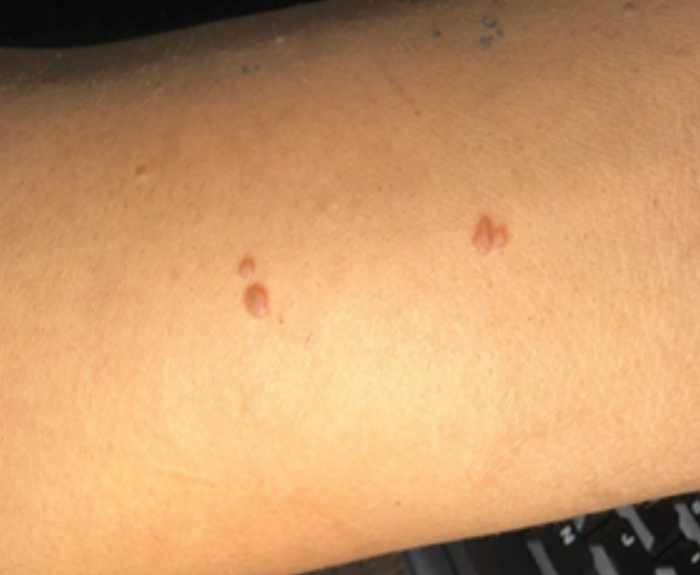
Quick Answer: Small, smooth, flat-topped, skin-coloured to pinkish bumps on the forearm — multiple and grouped — suggest flat warts (verruca plana), a common HPV infection especially frequent in children and young adults. Unlike common warts, they are small and flat rather than rough and bulky, often numerous, and favour the face, forearms, and hands. They spread through scratching, picking, shaving, minor trauma, and direct contact. Treatment options include topical retinoids, salicylic acid, cryotherapy, and selected destructive procedures — and never home removal, which spreads them. Case Snapshot: A patient asked: "Are these skin warts, or could it be something else?" — images showed small, smooth, flat-topped, skin-coloured to pinkish bumps on the forearm, multiple and loosely grouped. Their very un-wart-like smoothness is precisely why flat warts so often go unrecognised and untreated while they multiply. What Are Flat Warts? Flat warts (verruca plana) are a common viral infection caused by the Human Papilloma Virus (HPV) — but a different presentation from the rough cauliflower warts everyone recognises. Unlike common warts, they are: Small and flat rather than rough and bulky — often just 1–4 mm, barely raised Skin-coloured, pink, or light brown — camouflaged rather than conspicuous Multiple and grouped together — dozens are common Most often on the face, forearms, and hands They are especially common in children and young adults, whose immune systems are still learning to recognise this HPV family. How They Multiply The defining behaviour of flat warts is linear and clustered spread via the patient's own habits: Scratching or picking the lesions — dragging virus in a line across the skin (flat warts famously appear in scratch-line rows) Shaving — on men's beards and anyone's forearms/legs, the razor harvests virus from one wart and plants it along the stroke Minor skin trauma Direct skin contact These lesions are harmless but can slowly increase in number if left untreated — the typical story is "a few small bumps" quietly becoming forty over months of absent-minded scratching and routine shaving. The Treatment Options Flat warts occupy cosmetically visible, delicate skin, so treatment favours precision and gentleness: Topical retinoids — a mainstay for flat warts: they disrupt the infected surface cells across whole affected fields, well suited to numerous small lesions Salicylic acid preparations — gentler strengths appropriate to the site Cryotherapy (liquid nitrogen) — light, carefully dosed freezing, mindful of pigment changes in Indian skin Electrocautery or other destructive procedures in selected cases — for limited, stubborn lesions Many warts eventually resolve on their own — often abruptly, when immunity finally recognises them — but treatment can speed clearance and reduce spread, and stops the multiplication in the meantime. Explore our wart removal services for a plan matched to lesion number and site. The Behaviour Prescription While lesions are present: avoid scratching, picking, or attempting home removal — this spreads the virus to nearby skin. Additionally: shave around affected areas or pause shaving there (or switch to trimming), never share razors or towels, and moisturise itchy areas rather than scratching them. For facial flat warts, be especially conservative — home acids and picking on the face trade tiny bumps for lasting marks. A Note on Children Since flat warts favour the young, parents manage much of this condition: keep affected children's nails short and discourage picking; give each family member their own towel; and choose the gentlest effective clinic options — dermatologists deliberately favour painless field treatments (retinoid-based) over freezing for small children with many facial lesions. Spontaneous clearance is genuinely common in children, so guided patience is sometimes the prescribed treatment — a decision best made with, not instead of, a dermatologist. Wart or Something Else? The patient's actual question deserves its answer: flat warts have believable mimics — closed comedones, milia, molluscum, and certain benign facial bumps. The distinguishing habits (grouping, scratch-line arrangements, slow multiplication) plus dermoscopy give the dermatologist a quick, confident answer — worth obtaining before months of treating the wrong entity. When to See a Dermatologist See a dermatologist for confirmation of the diagnosis, for treatment when lesions are multiplying, facial, or cosmetically bothersome, and for children with numerous lesions where gentle field treatments are chosen carefully. Early treatment of a small colony is quick; a hundred-lesion field is a project. Book a consultation here. FAQs Q: Will flat warts go away without treatment? Often yes, eventually — sometimes suddenly and completely as immunity engages. But they commonly multiply first, and nobody can predict an individual's timeline; treatment shortens the story. Q: Can I keep shaving over them? Best not — shaving is a proven spreader. Trim instead, or shave around treated zones until cleared. Q: Are flat warts an STD? No — these are common cutaneous HPV strains spread by ordinary skin contact and self-spread, not sexual transmission. Q: Why did mine appear in a straight line? That's the Koebner-type signature of flat warts: a scratch inoculated the virus along its path — and the diagnostic clue that often confirms the condition. 📌 Case Study Reference: Publicly shared patient images and query, r/DermatologyQuestions, Reddit — "Are these skin warts or could it be something else?". Educational discussion only; not a final diagnosis. Clinical commentary by the Allodermis dermatology team.
Learn more