Case Study
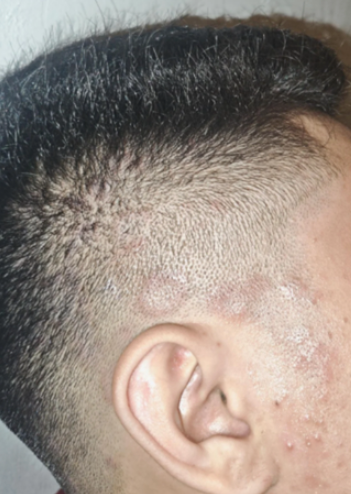
Case 50: A Scaly Patch Appearing on the Scalp Right After a Haircut — Sebopsoriasis, Not a Barbershop Infection
Quick Answer: A scaly patch along the hairline noticed hours after a haircut is more suggestive of sebopsoriasis or scalp psoriasis than any new infection from the haircut itself. Haircuts reveal existing scalp conditions by removing the hair that hid the scale — and clipper friction can aggravate underlying psoriasis (a Koebner-type response). Typical features: redness, white scaling, and flaking around scalp margins, ears, and forehead, with stress, infections, and skin trauma triggering flares. Treatment involves medicated shampoos and anti-inflammatory scalp lotions prescribed by a dermatologist — and avoiding scratching, harsh hair products, and friction. Case Snapshot: A worried patient wrote: "Recently got a haircut, 2 hours ago, and this appears on my scalp." Images showed a scaly patch along the hairline — and the two-hour timeline itself was the diagnostic key: no infection establishes visible scale in two hours, but two hours is exactly how long it takes to notice a pre-existing patch once the covering hair is gone. What the Haircut Actually Did Two innocent mechanisms explain the "haircut caused it" illusion: Revelation: haircuts often make existing scalp conditions more noticeable because the hair no longer hides the scale. The patch was there last week; the mirror access is what's new. Aggravation: in some people, minor trauma from clippers can aggravate underlying psoriasis — the Koebner phenomenon, where psoriasis-prone skin answers friction and micro-trauma with a fresh or brightened patch along the traumatised line. Neither mechanism involves catching anything at the barbershop — an important reassurance, and a redirection of attention from the barber's tools to the scalp's own biology. Sebopsoriasis and Scalp Psoriasis The appearance — redness, white scaling, and flaking around the scalp margins, ears, or forehead — fits the seborrheic-psoriatic spectrum. Sebopsoriasis blends features of seborrheic dermatitis (the oily-area dandruff condition) and psoriasis (thicker, better-defined silvery-scaled plaques); the hairline, behind-ear folds, and scalp margins are its favourite real estate. Stress, infections, and skin trauma can trigger flares — a trio worth knowing, since flare timing so often mystifies patients until these are named. Treatment — Aimed at Control, Done Correctly Treatment usually involves medicated shampoos and anti-inflammatory scalp lotions prescribed by a dermatologist. The practical points that make treatment actually work: medicated shampoos treat the scalp, not the hair — massaged onto the affected skin and left on several minutes before rinsing; anti-inflammatory lotions/solutions are applied to the patches themselves on the prescribed schedule; and thick scale may first need gentle softening so treatments reach the skin. Equally important is what to avoid: scratching, harsh hair products, and excessive friction to the area — every scratch and aggressive combing session is fresh Koebner fuel. Vigorous towel-rubbing, very hot water, and tight headwear over active patches join the avoid list. The Honest Frame: Control, Not Cure Sebopsoriasis and scalp psoriasis are chronic, relapsing-and-remitting conditions: excellent control is very achievable, permanent cure is not the promise. Flares will visit with stress and season; a maintenance rhythm (periodic medicated shampoo even when clear) keeps them short and small. Patients told this honestly stay the course; patients promised a cure abandon effective treatment at the first relapse. The Escalation Signals If the rash continues to spread, becomes very itchy, or develops hair loss, a dermatology evaluation is recommended to confirm the diagnosis and rule out other scalp disorders — including fungal scalp infection (which does cause hair loss and does spread from contact — the one scenario where the barbershop question genuinely returns), eczema, and other scaling conditions. Distinguishing these on examination — occasionally with a scraping — redirects treatment correctly. When to See a Dermatologist See a dermatologist for confirmation and prescription-strength treatment at the outset; promptly for spreading patches, significant itch, hair loss over the patch, or plaques appearing beyond the scalp (elbows, knees, nails — the psoriasis survey); and for a maintenance plan if flares keep returning. Book a scalp consultation here, and read about our full psoriasis care. FAQs Q: Could the barber's clippers have infected me? A visible scaly patch two hours post-cut wasn't seeded that day — infections take days to appear. Fungal scalp infection remains the differential your dermatologist excludes if things spread or hair sheds. Q: Is this dandruff or psoriasis? They sit on a spectrum: dandruff/seborrheic dermatitis flakes finer and more diffusely; psoriasis builds thicker, well-defined silvery plaques. Sebopsoriasis blends both — and the treatment plan adjusts accordingly. Q: Will I lose hair from this patch? Sebopsoriasis/psoriasis rarely cause true hair loss (temporary shedding from severe inflammation or scratching can occur and recovers). Progressive hair loss over a scaly patch points elsewhere — and merits review. Q: Should I skip haircuts now? No — just brief your barber to be gentle over affected areas, avoid aggressive clipper pressure there, and keep your maintenance treatment consistent around haircut days. 📌 Case Study Reference: Publicly shared patient images and query, r/DermatologyQuestions, Reddit — "Recently got a haircut, 2 hours ago, and this appears…". Educational discussion only; not a final diagnosis. Clinical commentary by the Allodermis dermatology team.
Learn more